Price Spikes to Supply Shocks: Why Food Tech is a Hedge
Opinion
Welcome back to our series exploring planetary boundaries, a scientific framework that sets recommend thresholds for human impact on Earth’s systems. In this series, we explore our food system's role in breached planetary boundaries and how food tech can offer solutions. See our other posts in the series here:
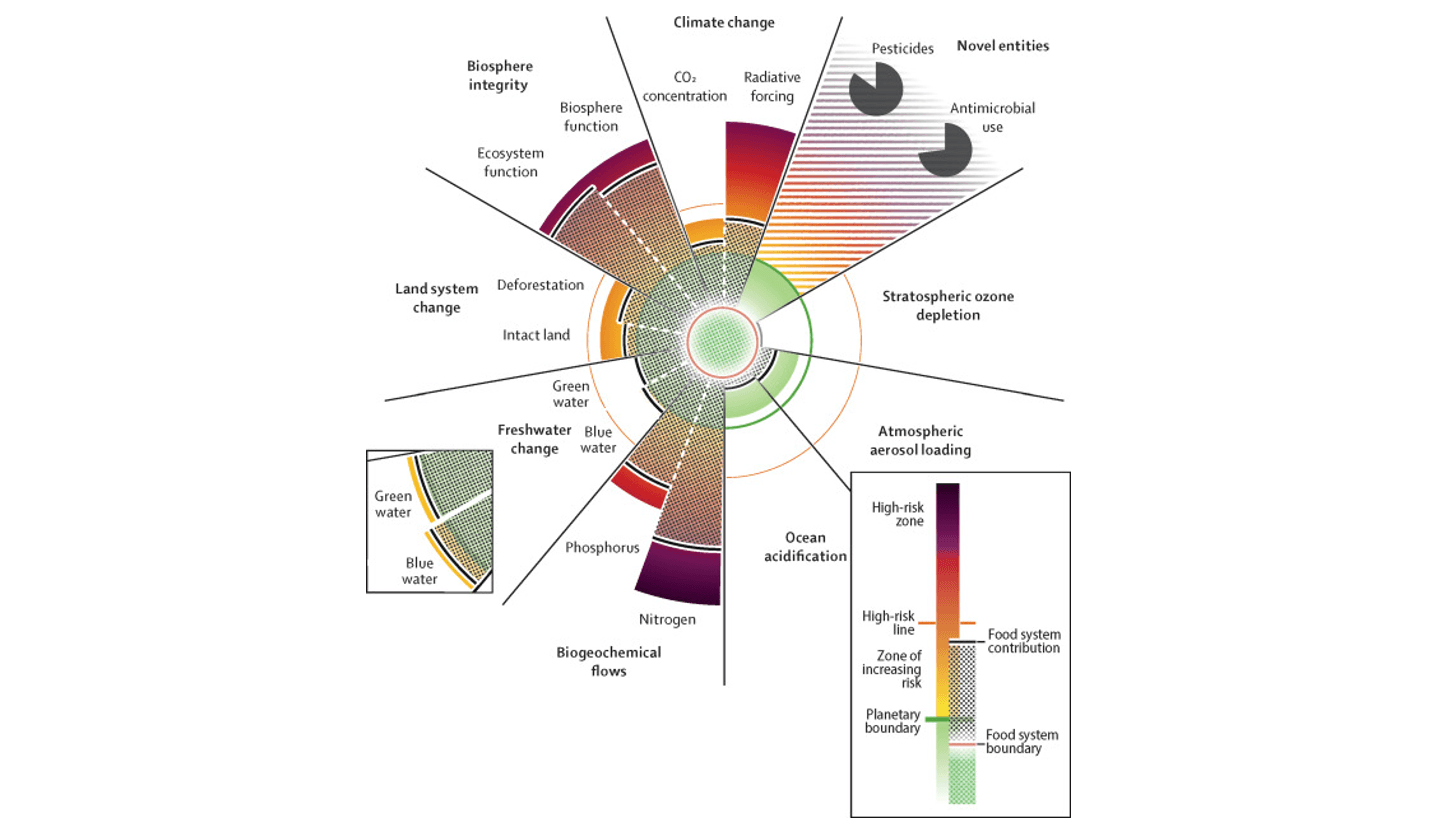
The climate change planetary boundary refers to the stability of Earth’s climate system, which is shaped by the delicate balance of greenhouse gases in our atmosphere. For thousands of years, this balance has allowed life to flourish under relatively stable temperatures. Human activity has dramatically altered that balance. The planetary boundaries framework uses atmospheric CO₂ concentration and radiative forcing as key indicators to measure how far we've pushed the climate.
Crossing this boundary doesn’t just mean warmer days, it means stress on food systems, water supplies, and human health. Atmospheric CO₂ levels have surged past the safe threshold of 350 parts per million, reaching over 420 ppm in recent years. [2] Global temperatures are rising faster than at any point in recorded history, with the last decade being the hottest ever observed. [3]
The consequences of breaching the climate change boundary ripple through every other part of the Earth system. Rising temperatures and warming oceans accelerate biodiversity loss by disrupting habitats. Warmer air holds more moisture which leads to heavier rainfall in some regions and prolonged droughts in others, altering the global water cycle. Increases in atmospheric carbon dioxide directly lead to ocean acidification, putting marine life at risk. Reducing food system greenhouse gas emissions would have beneficial impacts across the planetary boundaries.
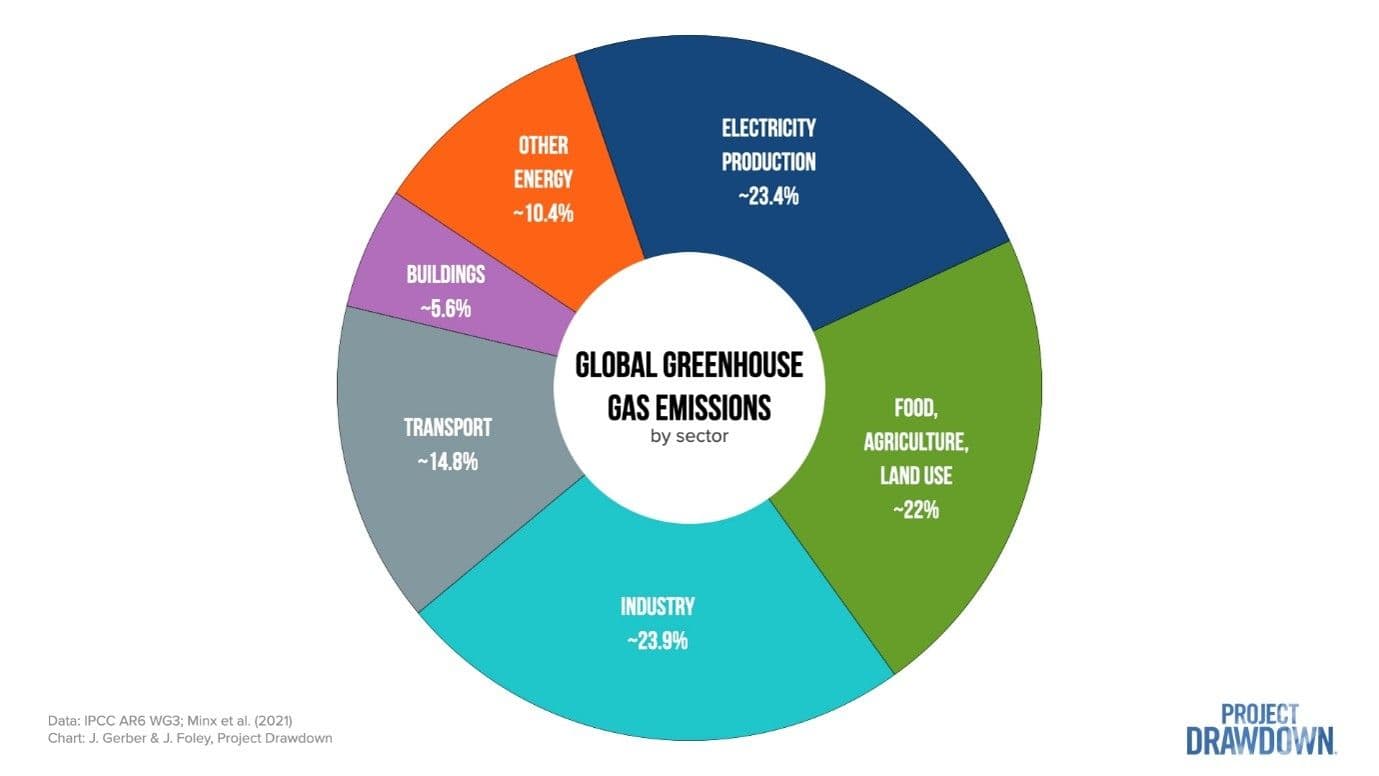
The primary sources of greenhouse gas emissions are energy, industry, agriculture, and transportation. Electricity production and other energy-related emissions are responsible for 33-35% global emissions, largely from burning coal, oil, and gas to power technology and control temperatures inside buildings. [4, 5] Industry, which is made up of manufacturing, building, chemicals, and metals, contributes another 21-24% of global greenhouse gases, driven by fossil fuel use and energy-intensive processes. [4, 5] Food, agriculture, and land use are responsible for 22-24% of greenhouse gas emissions. [4, 5] It is important to link food to land use, because as discussed in our land systems planetary boundary post, agriculture drives the vast majority of current deforestation. [4, 5] Finally, transport is another major contributor to greenhouse gas emissions, accounting for roughly 14–15% of global totals as we move people and products across the globe. [4, 5]
The global food system is a major driver of climate change, despite often being overlooked in climate discussions. When we include full food system emissions, including food waste, deforestation for food production, and supply chain emissions, the food system’s share rises to 34% of global greenhouse gas emissions. [5] Even if we stopped all other emissions today, global food system emissions alone could preclude achieving the 1.5°C and 2°C climate targets [6]. Within agriculture, animal agriculture stands out for its direct emissions, methane from ruminant digestion and manure, and its indirect impacts, such as land conversion for grazing and the production of animal feed. A recent study found that animal agriculture is the primary driver of climate change, responsible for 53% of global temperature increase since 1750, while fossil fuels account for just 19%. [7, 8] The key drivers of agricultural emissions are below.
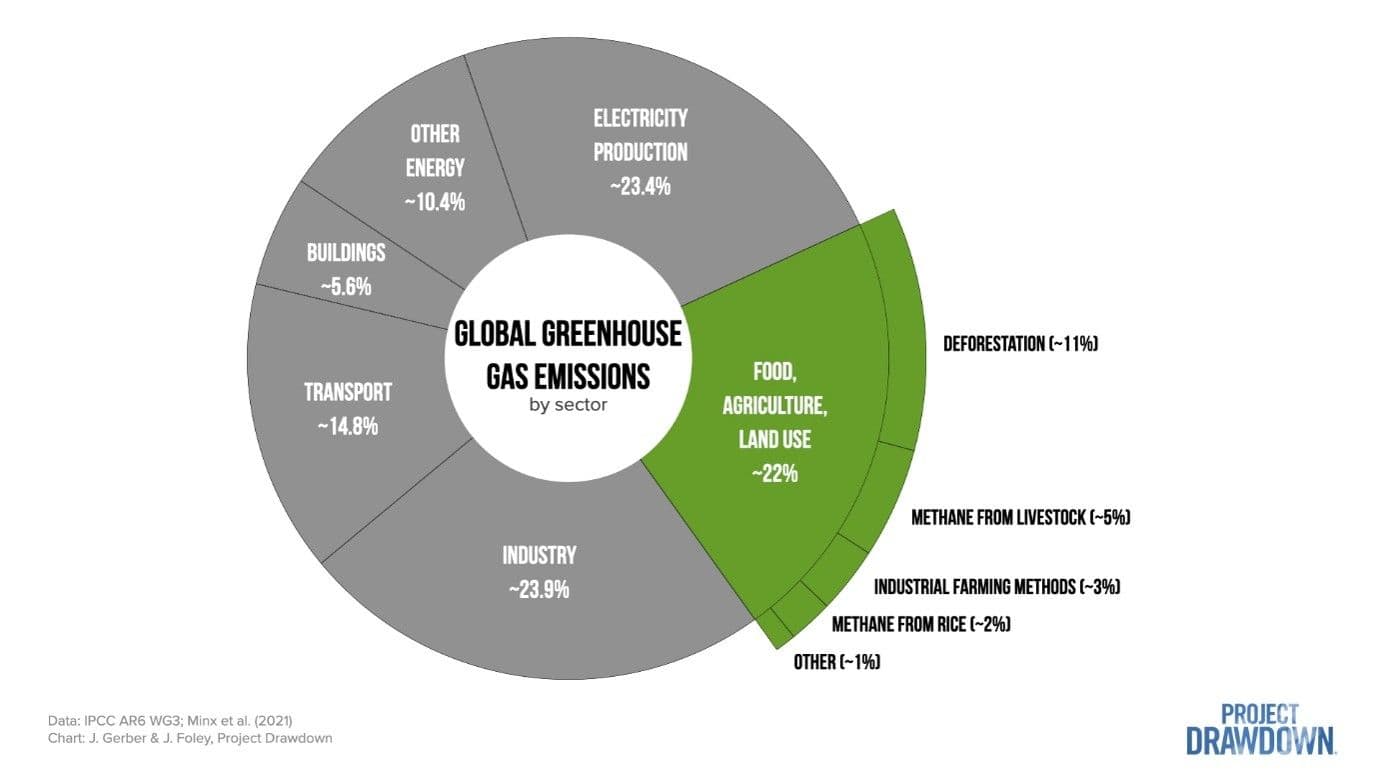
Agriculture-driven deforestation accounts for 10–11% of global emissions. [5, 9] Animal agriculture contributes the majority of this impact. Today, about half of Earth’s habitable land is used for agriculture, and roughly three-quarters of that land supports livestock -either through grazing or by growing feed crops. [10] Beef production is particularly destructive: in the Amazon, around 80% of deforestation over the past three decades has been linked to cattle, both for pasture and for feed cultivation. [11] Feed crops also consume vast areas of fertile land that could otherwise be used to grow food directly for people. Soy is a striking example: roughly 75% of global soy is fed to animals rather than consumed by humans. [12] As a result, shifting diets away from animal-based products is a key strategy to reduce deforestation and the associated emissions. [1]
Methane is another potent greenhouse gas, with agriculture responsible for roughly 45% of human-caused methane emissions. [9, 13, 14] Livestock, especially ruminants like cattle and sheep, produce methane through enteric fermentation, accounting for over 30% of anthropogenic methane emissions. [15] Flooded rice paddies also create low-oxygen environments where methane-producing microbes thrive, contributing about 8% of human-caused methane emissions. [15]
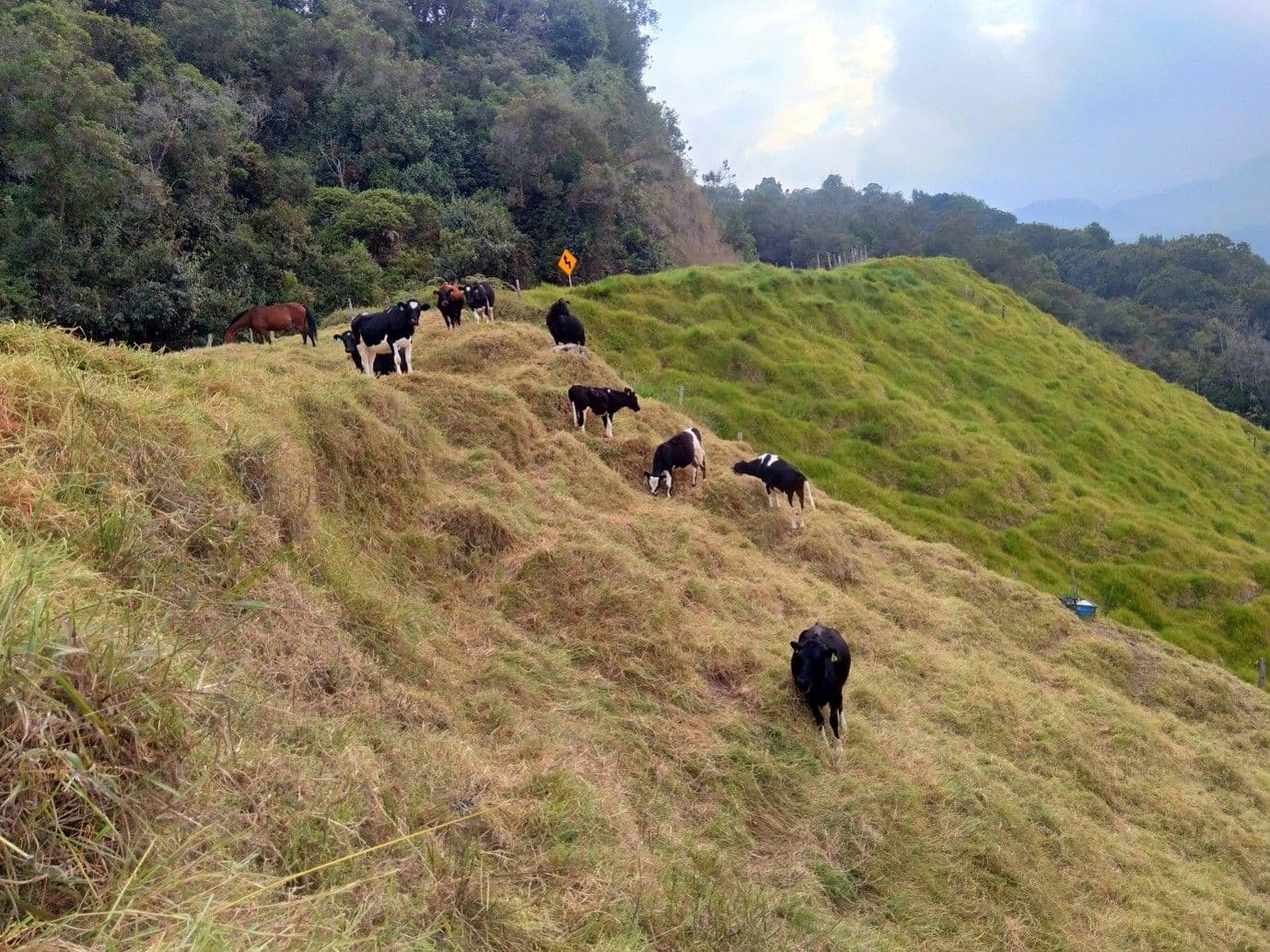
Agriculture is responsible for 81% nitrous oxide emissions, primarily from livestock manure and synthetic fertilizers. [13, 14] Fertilizer use falls under industrial farming methods. Crops typically absorb only about half of the nitrogen fertilizers that are applied. The remainder lingers in the soil, where microbes convert it into nitrous oxide, a greenhouse gas with a warming effect 273 times stronger than carbon dioxide over a century. [13, 16] Between 2000 and 2018, emissions linked to manure and synthetic fertilizer use climbed sharply, increasing by more than 20% and 30%, respectively. [13, 17] Much of the fertilizer applied globally goes to crops used as animal feed, amplifying the link between livestock and agricultural emissions.
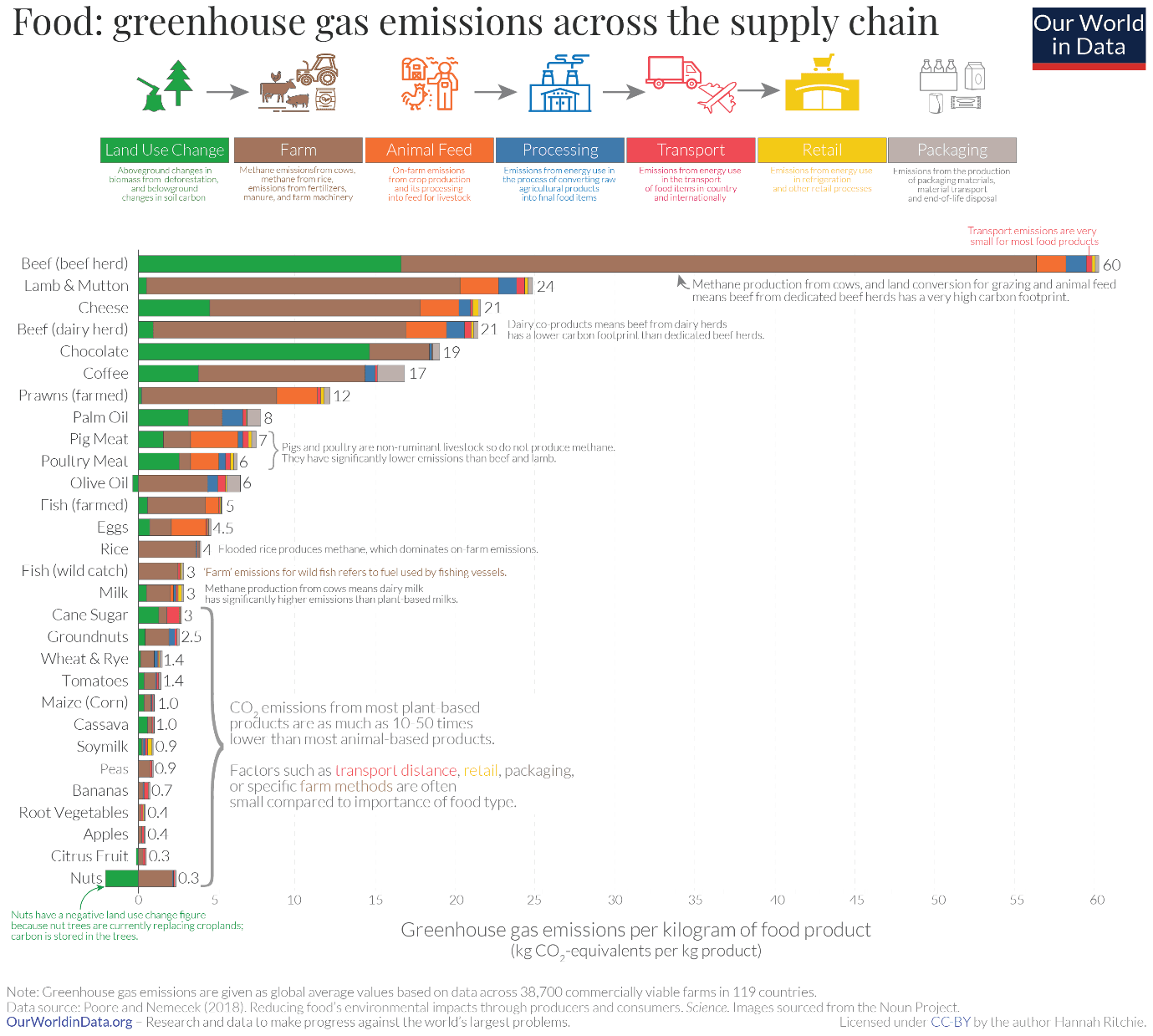
Greenhouse gas emissions from food vary dramatically by product. [18] Animal-based foods have outsized impacts because they require land for grazing or feed crops, which are inefficiently converted by livestock into food for humans rather than humans eating the crops directly. Ruminant meats like beef and lamb are the worst offenders in terms of total greenhouse gasses, as they also produce large amounts of methane. When looking at a food’s total footprint, transport and processing contribute only a small fraction. If we want to tackle agricultural emissions, we need to focus on the product. For example, choosing local beef has little emissions benefit, compared to the huge reduction that could come from choosing another protein. [19]
Getting back within the climate change planetary boundary isn’t just changing energy and transportation, we must also transform our food system. Food technology offers a powerful set of tools to address climate change by rethinking what we eat and how it is produced.
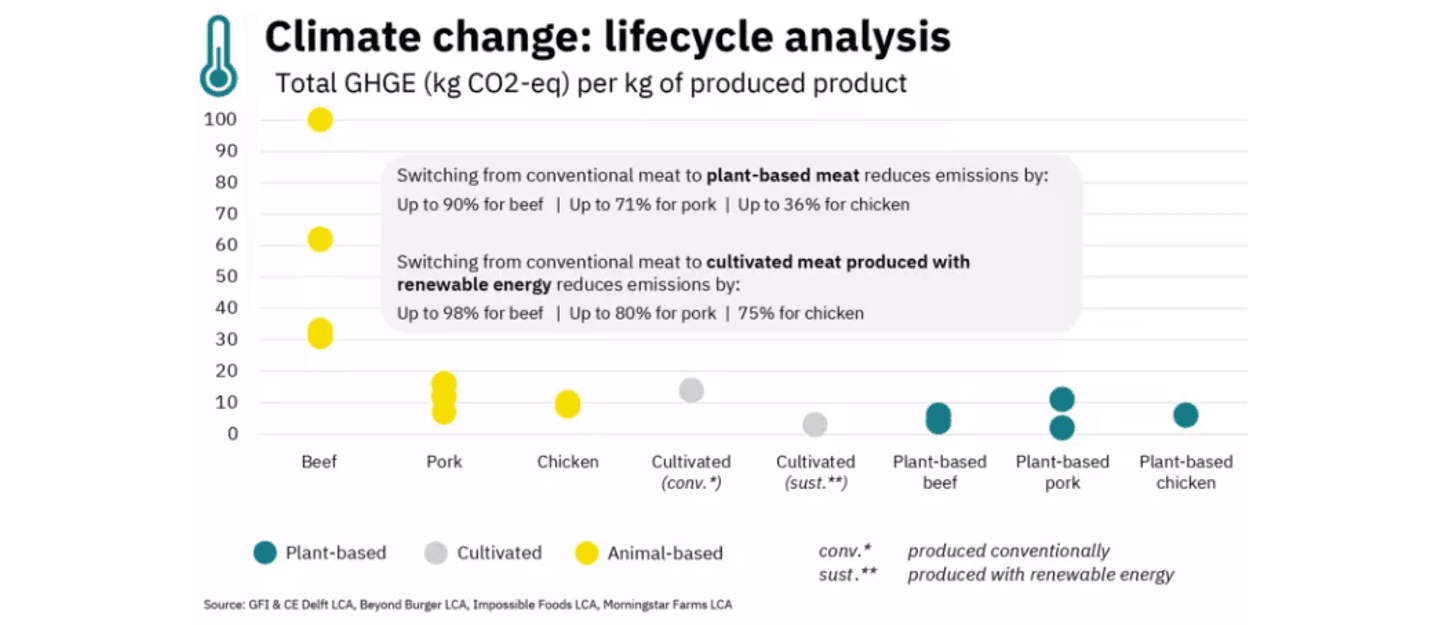
Animal agriculture is the largest contributor to food system emissions, primarily through methane from ruminants and carbon dioxide from deforestation for grazing and feed crops. Transitioning to plant-based, cultivated meat, and precision-fermentation animal product alternatives can dramatically reduce emissions from deforestation (more on that here) and eliminate ruminant methane emissions. For example, Redefine Meat makes highly realistic plant-based meat with a fraction of the environmental emissions. The production of one kilogram of Redefine’s beef emits 90% less GHG emissions than a beef burger. [20] Savor makes fats using chemistry processes. Savor’s butter could generate 67% fewer emissions per calorie than butter from cows. [21] Perfect Day produces dairy whey protein via precision fermentation. Compared to dairy protein in milk, Perfect Day’s whey generates 91-97% fewer greenhouse gas emissions. [22] Cultivated meat produced with renewable energy could reduce emissions by up to 80% for pork and 98% for beef. [23]
Additionally, foodtech innovators are tackling other high-impact ingredients with many of the same technologies being used to produce alternative meat and dairy. Cocoa production, for example, drives deforestation and generates significant greenhouse gas emissions. Companies like California Cultured and Planet A Foods are pioneering chocolate alternatives that replicate the taste and functionality of cocoa while dramatically reducing environmental impact.
Nitrous oxide emissions from fertilizers and manure are among the most potent greenhouse gases in agriculture. Emerging solutions include biological fertilizers that leverage soil microbes to deliver nutrients more efficiently, engineered crops with enhanced nitrogen update that reduce fertilizer needs, and robots that precisely apply fertilizer exactly where necessary. Pivot Bio uses nitrogen-fixing microbes to replace synthetic fertilizers, cutting emissions while maintaining productivity. Meanwhile, advanced robotic agtech companies like Ecorobotix are deploying AI-driven precision fertilizer application systems that reduce fertilizer overuse.
Food waste accounts for roughly 8–10% of global greenhouse gas emissions, driven by wastage across the supply chain. [1, 24] Foodtech innovators are deploying solutions that extend shelf life, optimize inventory, and upcycle byproducts into high-value ingredients. Hyfe is valorizing food waste streams to extract high-value specialty products. Apeel Sciences use plant-based coatings to slow spoilage, reducing waste at retail and consumer levels.
While methane-reducing feed additives for cattle are often promoted as emission-reductions solutions, their impact is limited. Because feed additives must be consumed daily, they only work in confined feedlot systems. Cattle typically only spend the final three months of their lives on these feedlots and produce just 11% of their lifetime emissions during this time. [25] Further, beyond methane, beef and lamb create additional emissions due to land use, feed, and manure. [26] In a best case scenario where almost all of feedlot methane emission could be mitigated, feed additives would only lead to an 11% reduction in lifetime emissions. [27] A more realistic enteric methane reduction of ~30% in cattle on feedlots would only reduce lifetime emissions by 3%. [28] Moving away from beef offers far greater emissions reductions than the best methane-reducing feed additives. Switching from beef to pulses would lead to a 98% reduction. [29]

Food technologies can reduce food system emissions and slow climate change. By reimagining what we eat and how it is produced, innovators are tackling agricultural emissions. Given the outsized emissions contribution of animal agriculture, shifting away from high‑emission animal products is essential. Fortunately, breakthroughs in food technology are providing exciting alternatives: plant‑based products that mimic animal meat, dairy and egg proteins produced via precision fermentation, upcycled ingredients, and more. Further, enabling technologies like continuous fermentation (Pow.bio) or strain engineering (TripleBar), can make these products more even more efficient and cost effective. By combining demand‑side shifts with production‑side technological leaps, we can build a food system capable of feeding a growing global population within planetary limits.
[1] Rockström, J., Haraksingh Thilsted, S. H., Willett, W. C., Gordon, L. J., Herrero, M., Hicks, C. C., Mason-D’Croz, D., Rao, N., Springmann, M., Wright, E. C., Agustina, R., Bajaj, S., Bunge, A. C., Carducci, B., … Vermeulen, S. & van Vuuren, D. P. The EAT–Lancet Commission on healthy, sustainable, and just food systems. Lancet 2025; S0140-6736(25)01201-2. https://doi.org/10.1016/S0140-6736(25)01201-2
[2] NASA Earth Science Division. Carbon Dioxide – Vital Signs of the Planet. Climate Change: Vital Signs. June 2025. https://science.nasa.gov/earth/explore/earth-indicators/carbon-dioxide/
[3] World Meteorological Organization. State of the Global Climate 2024. WMO-No. 1318 (2025). https://library.wmo.int/records/item/69455-state-of-the-global-climate-2024
[4] Chissell, C. (Ed.) The Drawdown Review: The Climate Solutions for a New Decade. Project Drawdown (2020). The PDF includes editor-in-chief Crystal Chissell, Dr. Katharine Wilkinson, and contributions from Project Drawdown staff. https://drawdown.org/sites/default/files/pdfs/TheDrawdownReview%E2%80%932020%E2%80%93Download.pdf
[5] Foley, J. (2024, July 10). Fixing food’s big climate problem. Project Drawdown Insights. https://drawdown.org/insights/fixing-foods-big-climate-problem
[6] Springmann, M., Clark, M., Mason-D’Croz, D., Wiebe, K., Bodirsky, B. L., Lassaletta, L., … Willett, W. C. Options for keeping the food system within environmental limits. Science, 366(6471), ea ba7357 (2020). https://doi.org/10.1126/science.aba7357
[7] Plant Based News. Animal agriculture is the leading cause of climate change, experts say. Plant Based News (2025). https://plantbasednews.org/news/environment/animal-ag-leading-cause-climate-change/
[8] Lynch, J., & Pierrehumbert, R. Climate impacts of cultured meat and beef cattle. Environmental Research Letters, 20(11), 114003 (2025). https://doi.org/10.1088/1748-9326/adb7f2
[9] Mbow, C., Rosenzweig, C., Barioni, L. G., Benton, T. G., Herrero, M., Krishnapillai, M., … Tubiello, F. N. Chapter 5: Food Security. In: Climate Change and Land: An IPCC Special Report on Climate Change, Desertification, Land Degradation, Sustainable Land Management, Food Security, and Greenhouse Gas Fluxes in Terrestrial Ecosystems (2019). IPCC. https://www.ipcc.ch/srccl/chapter/chapter-5/
[10] Ritchie, H., & Roser, M. Half of the world’s habitable land is used for agriculture. Our World in Data (2019). https://ourworldindata.org/global-land-for-agriculture
[11] Skidmore, M. E., Moffette, F., Rausch, L., Christie, M., Munger, J., & Gibbs, H. K. Cattle ranchers and deforestation in the Brazilian Amazon: Production, location, and policies. Global Environmental Change, 68, 102280 (2021). https://doi.org/10.1016/j.gloenvcha.2021.102280
[12] Fraanje, W. & Garnett, T. (2020). Soy: food, feed, and land use change. (Foodsource: Building Blocks). Food Climate Research Network, University of Oxford. https://www.tabledebates.org/building-blocks/soy-food-feed-and-land-use-change
[13] Triple Helix Institute and Synthesis Capital. AgTech: Reducing Emissions. Triple Helix Institute Resources (2025). https://www.triplehelix.institute/resources/agtech-reducing-emissions
[14] IPCC. Summary for Policymakers. In: Climate Change and Land: An IPCC Special Report on Climate Change, Desertification, Land Degradation, Sustainable Land Management, Food Security, and Greenhouse Gas Fluxes in Terrestrial Ecosystems (2019). https://www.ipcc.ch/srccl/chapter/summary-for-policymakers/
[15] United Nations Environment Programme (UNEP). Global Methane Assessment: Benefits and Costs of Mitigating Methane Emissions. UNEP (2021). https://www.unep.org/resources/report/globalmethane-assessment-benefits-and-costs-mitigating-methane-emissions
[16] Millar, N., Robertson, G. P., Grace, P. R., Gehl, R. J., & Hoben, J. P. Management of Nitrogen Fertilizer to Reduce Nitrous Oxide Emissions from Field Crops. Michigan State University Extension (2014). https://www.canr.msu.edu/resources/management_of_nitrogen_fertilizer_to_reduce_nitrous_oxide_emissions_from_fi
[17] Food and Agriculture Organization of the United Nations (FAO). Emissions due to agriculture: Global, regional and country trends 2000–2018. FAO (2020). http://www.fao.org/3/cb3808en/cb3808en.pdf
[18] Ritchie, H. Environmental impacts of food production. Our World in Data (2023). https://ourworldindata.org/environmental-impacts-of-food
[19] Ritchie, H. Food choice vs. eating local: Which reduces your environmental impact more? Our World in Data (2020). https://ourworldindata.org/food-choice-vs-eating-local
[20] Redefine Meat. Environment – How we reduce impact. Redefine Meat (2025). https://www.redefinemeat.com/environment/
[21] Davis, S. J., Alexander, K., MorenoCruz, J. B., Hong, C., Shaner, M., Caldeira, K. & McKay, I. Food without agriculture. Nature Sustainability, 7, 90–95 (2023). https://doi.org/10.1038/s41893-023-01241-2 Cruz, J.Cruz, J.‑Cruz, J.
[22] WSP. Comparative Perfect Day Whey LCA Report prepared for Perfect Day. WSP (2021). https://perfectday.com/wp-content/uploads/2022/01/Comparative-Perfect-Day-Whey-LCA-report-prepared-by-WSP_20AUG2021_Non-Confidential-1.pdf
[23] The Good Food Institute. Environmental benefits of alternative proteins. GFI (n.d.). https://gfi.org/initiatives/climate/environmental-benefits-of-alt-proteins/
[24] UNFCCC. Food loss and waste account for 8–10% of annual global greenhouse gas emissions, cost USD 1 trillion. United Nations Climate Change News (2024). https://unfccc.int/news/food-loss-and-waste-account-for-8-10-of-annual-global-greenhouse-gas-emissions-cost-usd-1-trillion
[25] Rotz, C. A., Asem‑Hiablie, S., Place, S., & Thoma, G. Environmental footprints of beef cattle production in the United States. Agricultural Systems, 169, 1–13 (2019). https://doi.org/10.1016/j.agsy.2018.11.005
[26] Foley, J. Greenwashing and denial won’t solve beef’s enormous climate problems. Project Drawdown Insights (2024). https://drawdown.org/insights/greenwashing-and-denial-wont-solve-beefs-enormous-climate-problems
[27] Dutkiewicz, J. Do Not Pin Your Hopes for Guilt‑Free Hamburgers on Seaweed. The New Republic (2024). https://newrepublic.com/article/187421/cows-beef-dairy-seaweed-emissions
[28] Hegde, S. Cattle Methane Inhibitors: Progress and Next Steps. World Resources Institute (2025). https://www.wri.org/technical-perspective/cattle-methane-inhibitors-early-adoption-next-steps
[29] Ritchie, H., & Roser, M. Greenhouse gas emissions per 100 g of protein (Poore & Nemecek, 2018). Our World in Data (n.d.). https://ourworldindata.org/grapher/ghg-per-protein-poore
This website uses strictly necessary cookies to enable the website to function, namely to secure our website and to save certain preferences and repeat visits, including recording your cookies preferences.
If you agree, we would also like to use non-essential cookies to enable us to observe traffic levels to the website which allows us to understand interaction with the website and helps us to improve the website and our services.
To learn more about this, visit our Cookie Policy. You may consent or decline to the use of non-essential cookies by clicking “Accept Cookies” or “Decline Cookies” below.